
 Book a consultation

A malignant form of dog cancer has been successfully treated in Lithuania for some time
January 27, 2026
Until recently, cancer of fat cells, also known as mastocytoma, posed a significant challenge for both veterinarians and the animals themselves. It used to require surgical removal not only of the tumor itself but also of a large amount of surrounding tissue, and guaranteeing the removal of all metastases was almost impossible. In such cases, the tumor would regrow, leading to repeated surgeries, until the animal’s outcome was ultimately grim. However, with the discovery of a new treatment, this aggressive cancer can now be successfully cured in a relatively short time without any surgical intervention, according to a press release.
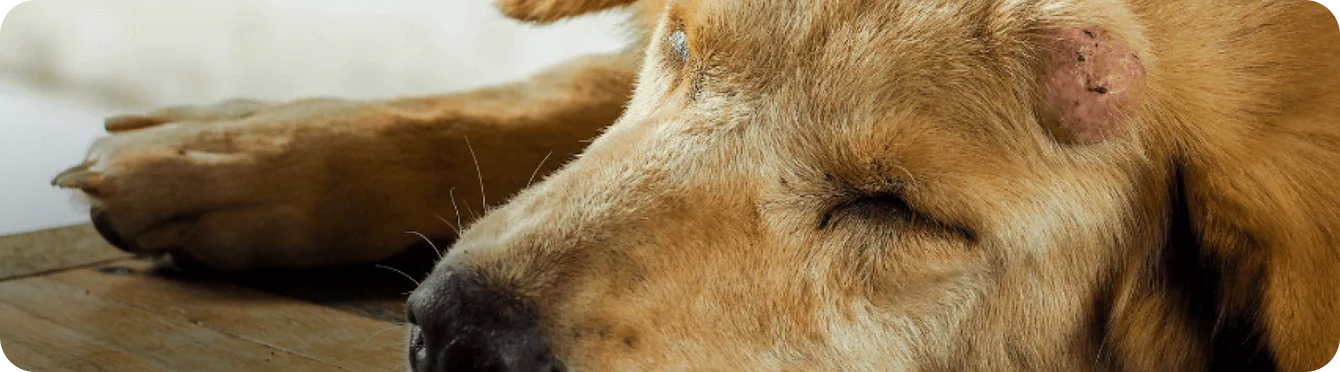
You should be concerned if, while petting your dog, you feel skin growths that resemble warts, moles, or papillomas.
These lumps should be shown to a veterinarian, who will most likely advise monitoring the affected areas, and if they start to grow (for example, even a small lump can double in size within a month), it is necessary to visit urgently again and perform a biopsy of the affected area – it is possible that your dog has developed a mast cell tumor, also known as mastocytoma.
It is a fairly common skin and subcutaneous cancer that, if untreated or delayed, can spread to other organs – lymph nodes, spleen, liver, or bone marrow – and can kill the animal fairly quickly.
“When we diagnosed this disease earlier, we had to surgically remove the tumor itself along with at least 3, preferably 5 centimeters of surrounding tissue. But knowing that mastocytomas often occur on a dog’s muzzle, paw, or near the anus, it was particularly difficult to operate properly and remove all metastases. Much also depended on the size of the dog – operating on a Labrador is one thing, removing metastases from a small breed puppy is quite another. However, now, with the advent of a new treatment, we cannot stop celebrating our achievements – in the nine months we have been using the new medicine, we have completely cured six dogs,” says Vytautas Siaurys, founder of the veterinary clinics “Siaurys Schnauzer.”
The doctor says that the new medicine was created completely by accident in Australia from berries that grow there. It was accidentally noticed that the effect of these berries specifically on liposarcoma cells is destructive.
The discoverers rushed to distribute the medicine worldwide. In other countries, it is already being used successfully, while in Lithuania and even in the Baltic states, this preparation was used for the first time at the clinic founded by V. Siaurys on a puppy named Rikis.
Rikis’ path to recovery
In the world, there have been only 28 cases of mastocytoma successfully treated with the new drug when people from Kaunas expressed their desire to try it in Lithuania.
It was in July of last year when Rikis was given access to the new treatment under special arrangements.
“I can’t say we weren’t worried – Rikis’s tumor was growing rapidly, and after diagnosing the dog with mastocytoma through cytological tests, we had to decide together with the owners what to do next – whether to surgically remove the 6.5 cm tumor or try the new drug. The owners trusted us and chose the medication – safely removing the tumor in the neck area would have been very difficult,” recalls V. Siaurys.
The owner must prepare morally for the healing process, and if the nerves are weaker, it is better to leave the pet in the clinic’s inpatient for a week, because the drugs are injected directly into the tumor and already on the first or second day the tumor begins to fall out in pieces. It is strictly forbidden to bandage or clean the wound unless the animal itself reaches for licking.
“Psychologically, it was very difficult for both us, doctors who have seen it all, and Rikis’ owners to watch as nasty, dark pieces fell from the puppy’s neck. When the entire tumor is gone in about a week, you can see separate pits in the areas where metastases had spread deeper. Everything was safely and cleanly eliminated, and the wound healed surprisingly quickly and nicely. There is almost no trace that there was a huge growth there,” says the veterinarian. “Previously, when removing such tumors, we would inevitably affect nerves and blood vessels, but the peculiarity of this drug is that it destroys the bad cells without harming the good ones, without damaging nerves or blood vessels.”
V. Siaurys boldly calls the new treatment a breakthrough in veterinary medicine, as studies have already begun to see whether these berries, which grow in Australia, affect other types of cancer as well. We just have to wait for the results and hope for the best.
Related posts
-
 February 11, 2026
-
 January 28, 2026
An idea for an exceptional gift!
Read more -
 January 28, 2026
True stories: beloved pets were suggested to be put to sleep. They were given hemodialysis for their second birthday.
Read more -
 January 28, 2026
Complications that can deprive an animal of the ability to move are now treatable
Read more -
 January 27, 2026
Snow and cold can cause serious discomfort to a pet: what do you need to know?
Read more