Book a consultation

Tracheal collapse treatment
Tracheal collapse is a common disease in small breed dogs, such as Yorkshire Terriers, Chihuahuas, Pomeranians, etc. It can also occur in cats, but this is extremely rare. Tracheal collapse obstructs the entry of air into the lungs, causing the animal to suffocate and have a dry, sharp cough. The sound made by the animal is sometimes described as a “goose honk.” The cough may worsen at night, during excitement, when the trachea is compressed (for example, by a collar), in hot or humid weather, or immediately after eating.
Tracheal collapse usually manifests in middle-aged and older dogs (4-14 years old), but it sometimes occurs in younger dogs as well. The disease is hereditary, so it is not recommended to breed affected dogs.
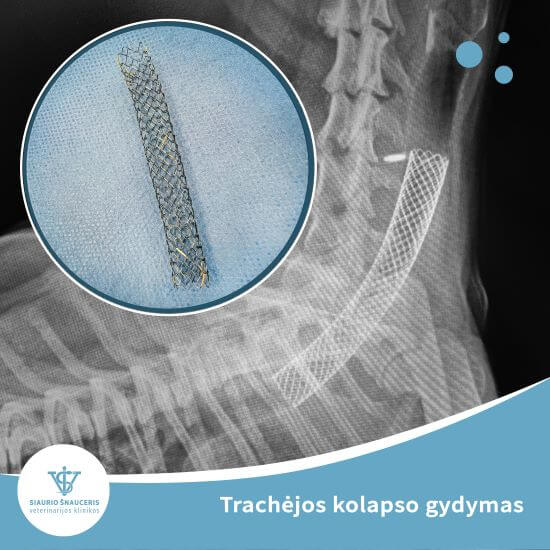
Tracheal collapse is classified into 4 grades and can only be treated surgically. We can determine the exact grade of the disease by performing X-ray or bronchoscopy examinations. Grade 1 and 2 collapse can be controlled medically for a while, but the disease gradually progresses and eventually requires surgery. In the case of grade 3 or 4, the only way to help your pet is tracheal stenting surgery. The surgery is minimally invasive; during the procedure, with the help of an endoscope, a stent of the required size is placed into the narrowed part of the trachea, thereby mechanically expanding it and clearing the path for air to enter the lungs.
In the provided photo, you can see what the stent itself looks like (a cylindrical, rigid yet flexible construction), and in the X-ray photo – the stent inserted into the narrowed trachea of a Yorkshire Terrier.
Today, tracheal collapse is no longer a sad sentence, and tracheal stenting is a modern, life-saving procedure for puppies!